Relational Art Site + Creative Tourism
How creativity reshapes places
Guest Lecture on "Socially Embedded and Revitalization Engaged Art in Rural Japan and China"
at Ca' Foscari University of Venice (GESSHIN).
Invited talk - Art in the Countryside at German Institute for Japanese Studies: DIJ Tokyo, Aug 2022

Selected Publication on Creative Rurality + Regional Art Festivals + Art Archipelago
Qu, M. (2026). Revitalization at a Price? Intermittent Art Festivals on Peripheral Archipelagos. Journal of Marine and Island Cultures, 15(1), 1–23. https://doi.org/10.21463/jmic.2026.15.1.07
Qu, M., Yamamura, T., & Jang, K. (2025). Art and pop culture tourism as creative dialogue for rural revitalization. Wakayama Tourism Review, 7, 12–15. https://doi.org/10.19002/0002007308
Qu, M. (2024). Regenerative art tourism for creative revitalisation in peripheral communities. In Duxbury, N,. Rahim, S,. Silva, S,. Castro, T, V. (Eds.), Creative Tourism, Regenerative Development, and Destination Resilience, 87-100.
Funck, C., & Qu, M. (2024). Art tourism and paradigms of island revitalization in Japan. Contemporary Japan, 36(1), 20-40. https://doi.org/10.1080/18692729.2024.2306112
Qu, M., & Funck, C. (2021). Rural art festival revitalizing a Japanese declining tourism island. Nancy Duxbery Eds, In Cultural Sustainability, Tourism and Development (Re)articulations in Tourism Contexts, (pp. 51-68). Routledge. DOI: 10.4324/9780367201777-6
Qu, M. (2019). Art Interventions on Japanese Islands: The Promise and Pitfalls of Artistic Interpretations of Community. The International Journal of Social, Political and Community Agendas in the Arts 14 (3): 19-38. doi:10.18848/2326-9960/CGP/v14i03/19-38.
Qu, M. (2017). The Aesthetic Experience of Augmented Reality Art. In J. J. Arango, A. Burbano, F. C. Londoño, & G. M. Mejía (Eds.), ISEA2017 Manizales BIO-CREATION AND PEACE (pp. 79–86). Manizales: Department of Visual Design, Universidad de Caldas, and ISEA International. ISBN: 978-958-759-161-3.

“UKOAPKAS”
A Cross-Cultural Artistic Journey between Aboriginal and Ainu Peoples
The documentary UKOAPKAS, directed by Associate Professor Meng Qu, captures a rare cross-cultural encounter between Aboriginal artists from Australia and Ainu artists in Nibutani, Hokkaido, in June 2024. Through a collaborative lino-print workshop, the artists brought their distinct traditions into dialogue and explored new forms of creative expression.
Qu approaches the encounter through the lens of relational art, focusing on how artistic collaboration can foster mutual understanding across cultures. The film traces the artists’ shared respect for natural materials and reveals how creative practice can connect Indigenous knowledge, cultural continuity, and sustainable futures.
Produced by Assistant Professor Kanako Uzawa, UKOAPKAS presents art as more than an aesthetic practice: it becomes a medium for building relationships, negotiating cultural difference, and opening new possibilities for Indigenous expression in an interconnected world. The project was supported by Hokkaido University’s GSI, the Australia-Japan Foundation, and Biratori Town.


Art Island Center
Art, Research, & Island Encounters
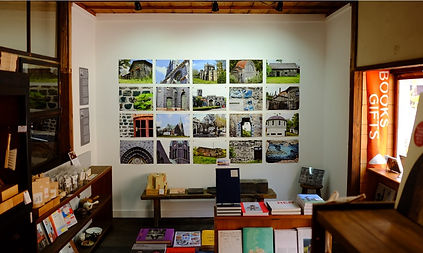
As Research Director of Art Island Center on Naoshima, I use the Center as a relational art site where artistic practice, academic research, and island communities come into dialogue. I organize island workshops, international conferences, and art-and-research tours across the Seto Inland Sea, bringing together artists, researchers, students, residents, and visitors.
Through these activities, I explore how art can create relationships across people and places, generate knowledge about island identity and resilience, and contribute to sustainable and creative futures for peripheral communities. Art Island Center therefore serves not only as a gallery and cultural space, but also as a field-based platform for collaborative research, cross-cultural exchange, and relational place-making.